1. Updates
As the condition of a structure evolves over time, this file must be updated. This obligation exists, of course, for works where health and safety coordination applies, but also when it does not apply.
Art. 43. - § 1. - A subsequent intervention file, the content of which complies with that described in Articles 34 and 36, is drawn up for works relating to the structure, essential elements of the structure, or situations involving a detectable hazard.
§ 2. - The subsequent intervention file referred to in § 1 is drawn up by the client or by a third party designated by them.
The client also ensures that the subsequent intervention file is adapted to any modifications made to the project during its implementation.
We believe that the most suitable person for this update is the building manager. An indexing system allows for easy updates. For this purpose as well, an electronic version of this document will be provided to the client.
2. Transmission
In addition to handing over the document to the new owner in the event of the sale of the structure, the transmission of information to future stakeholders is also the responsibility of the client:
Art. 48. - In order to enable the new owner to fulfil their future obligations as client for any subsequent works on the structure, the person or persons transferring the structure shall hand over the subsequent intervention file to the new owner upon each total or partial transfer of the structure.
This handover is recorded in the deed confirming the transfer.
Furthermore, each owner of the whole or part of the structure shall keep a copy of the subsequent intervention file available to any person who may act as client for subsequent works, in particular a tenant.
Art. 49. - § 1. - The client is required to make available to the coordinator or, in their absence, to the contractor, the parts of the subsequent intervention file that concern them, at the time when these persons are involved in the coordination or execution of subsequent works on the structure.
§ 2. - Before starting subsequent work on the structure, the coordinator or, in their absence, the contractor shall request the client to make available to them the parts of the subsequent intervention file that concern them.
The client may use this document as a working basis for drawing up the safety and health plan for the design phase of any subsequent work.
The architectural plans (as-built) as well as the structural plans (latest revision) that have normally been provided to you by the relevant firms will give you an overall view of the structure and, together with this S.I.F form the starting point for any subsequent intervention.
In the annex, forms intended for future stakeholders make it easy to fulfil this obligation to transmit information.
List of documents attached to the S.I.F
1. Administrative documents
- Planning permission, environmental permit, operating permit, etc.
- Asbestos inventory and other hazardous products
- Soil studies
- Specifications, bill of quantities, purchase orders, detailed invoices
2. "As-built" plans
As-built plans are essential for all subsequent modifications.
Their use, as a support and source of information, enables the establishment of a management and maintenance system integrating the prevention of risks in terms of occupational health and safety.
· Structural plans:
These include the load-bearing elements (slabs, beams, columns, etc.) with the admissible loads.
They are essential in the event of transformation, extension or change of use of premises or the entire building.
Reinforcement plans will be part of these plans.
· Architectural plans:
In particular:
- Plans of underground car parks with actual dimensions of access and internal circulation routes (actual clear height and width)
- Plans of façades and roofs with survey of permanent anchorages (RD 22.04.2006 H.S.C.P. and Co-ownership)
· Special techniques plans:
In particular:
- Main zones: heating, air conditioning, electricity, lifts, and access for future maintenance and replacements.
- Lifts and goods lifts with indication of loads and useful dimensions
3. Technical and maintenance files
Contractors are required to provide a technical and maintenance file relating to their works. This file must be inserted into the S.I.F.
4. Emergency plans and instructions
Emergency plans and alert, alarm and evacuation instructions, as well as the "fire file" handed over to the fire brigade, are to be drawn up by the client.
5. Use of hazardous products
List of chemical products used on the site, their location, stored quantities, technical data sheets, safety measures to be taken during use, etc.
6. Technical data sheets and layout plans for collective protection equipment (CPE) and personal protective equipment (PPE) integrated into the structure
Location, operating procedure and capacities of CPE and PPE integrated into the structure or available on site.
Technical and safety data sheets for all special products.
See intervention procedure in the sheets.
7. Information relating to structural and essential elements of the structure:
Explanations and comments from the structural engineer.
Prestressed elements, tensioned elements, underpinning, floor load-bearing capacity (ref. plans), etc.
8. Information relating to the nature and location of detectable or hidden hazards:
Hidden hazards arising from the works concerned or discovered during the works.
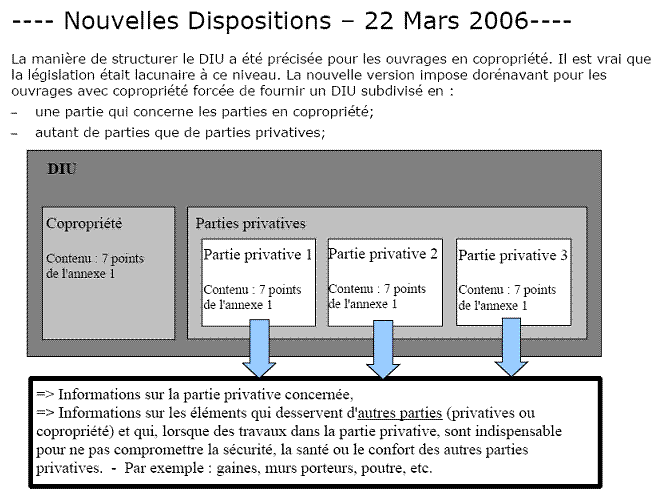
The Subsequent Intervention File and Co-ownership
AFrom 22 April 2006, all apartments placed under co-ownership must be sold with a specific S.I.F